



Build a bridge, not a permanent label
A student growth profile is useful across grade levels when it helps a new teacher understand what the student is learning, what conditions support that learning, and what might be worth trying next. It should not read like a verdict on ability or a summary of a child’s identity. Students change, classrooms change, and a strategy that helps in one setting may not be the right fit in another.
Think of the profile as a bridge between learning experiences. A fourth-grade teacher might record that a student explains mathematical thinking clearly with a diagram, while written explanations are still developing. A fifth-grade teacher can use that information to invite the student to compare diagrams with written reasoning—not assume the student will always need diagrams or struggle with writing. The profile begins a useful conversation; it does not replace one.
Choose information that can travel
A profile becomes harder to use when it collects everything. Prioritize a small set of recurring, decision-relevant information: a student’s current goal, a few examples of learning, strategies or conditions that have helped, and a question or next step for the receiving educator. Where appropriate, include the student’s perspective and a family insight that is relevant to supporting learning.
Make entries specific enough to guide action. Instead of “needs help with reading,” record an observable learning focus, such as “is practicing how to cite a detail from a text when explaining an inference.” Add a dated example and what the student tried. Use neutral language, distinguish observation from interpretation, and note when evidence is limited. This gives the next teacher something to check rather than a label to inherit.
Keep evidence and interpretation distinct
A strong profile lets readers see the difference between what happened and what someone concluded. For example: “During two recent group discussions, the student shared an idea after having time to jot a note” describes an observation. “The student is not a confident speaker” is an interpretation that may overgeneralize. Keeping these separate makes it easier for the next teacher to ask whether the pattern holds in a different group, subject, or moment.
Include enough context to make examples understandable: the task, the support available, and what the student did. A work sample without context can be misleading; a note without an example can be difficult to verify. If an earlier interpretation no longer fits, update it. A profile should show learning over time, not preserve outdated assumptions for the sake of continuity.
Design for change across grades
Use a consistent structure from year to year, but allow goals and evidence to change. A stable set of prompts—“What is the student working toward?”, “What evidence shows progress?”, “What helps?”, and “What should the next educator explore?”—makes it easier to follow a thread without expecting identical assignments in every grade. Teachers can add grade-specific examples while keeping the core questions familiar.
Look for development, not just repetition. A student who once benefited from an adult modeling a writing plan might now choose a planning strategy independently. Record that shift. Also note when support was useful in a particular setting rather than presenting it as universally necessary. This creates a clearer picture of growing independence and helps the next teacher decide whether to continue, adapt, or gradually reduce a support in conversation with the student.
Make students and families participants
Invite students to help describe what belongs in their profile. Ask questions such as, “What are you proud of learning?”, “What helps when work feels challenging?”, and “What would you like your next teacher to know?” Offer ways to respond that fit the student’s communication preferences. Their words can reveal interests, goals, and strategies that may not be obvious in a work sample.
Families can add valuable context about a student’s interests, strengths, or learning routines, while educators remain responsible for careful, relevant documentation. Explain the purpose of the profile in plain language and make space for families to correct misunderstandings or share a different perspective. Keep entries respectful and focused on supporting learning; avoid including sensitive details that are not needed for the educational purpose.
Make the handoff a conversation
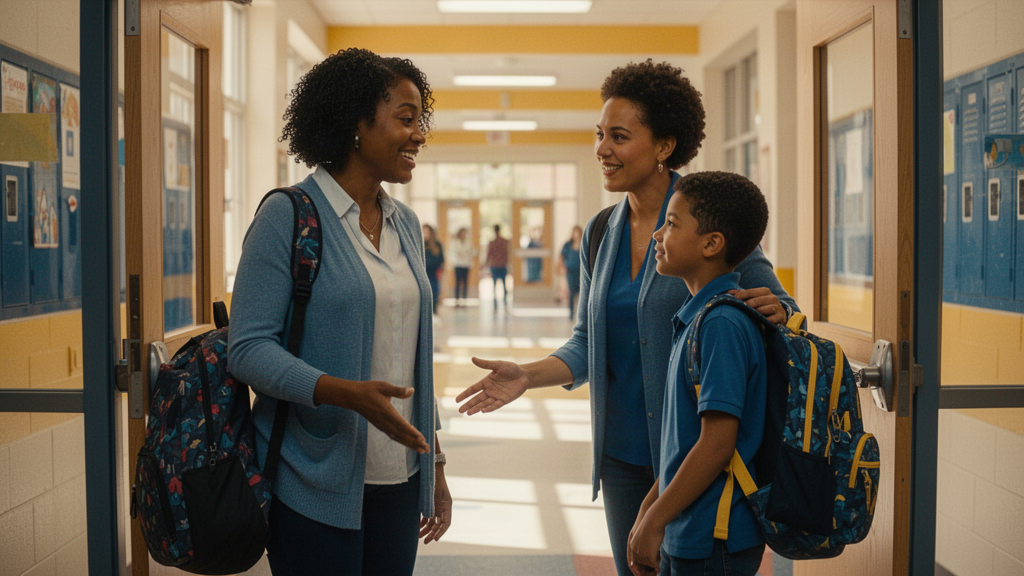
A profile is most useful when a receiving teacher can ask follow-up questions. During a transition meeting, review one or two meaningful examples, discuss what has changed, and identify a first move to try. The student might explain which strategies feel helpful, while the previous teacher can clarify the context of a work sample. The receiving teacher can then check the profile against new classroom evidence rather than treating it as a complete account.
If staff use a digital portfolio or longitudinal growth profile, the same principles apply: organize information for human review, protect student dignity, and make room for updates and context. ONWARDology is a synthetic-data preview, not a production school system. It can serve as a conceptual example, but it should not be presented as a live platform or used to imply real student records or outcomes. The broader K–8 Student Digital Portfolios & Longitudinal Growth Profiles approach is most valuable when thoughtful documentation supports relationships and next steps.
A practical checklist for each transition
Before sharing a profile, educators can use this checklist:
• State the student’s current learning goal in clear, specific language.
• Add one or two recent, dated examples that show what the student did and in what context.
• Describe strategies or conditions that helped, without suggesting they define the student.
• Separate observable evidence from educator interpretation; flag uncertainty where it matters.
• Include the student’s perspective and relevant family insight when available.
• Note a realistic next question or action for the receiving teacher.
• Review old entries for accuracy, relevance, and respectful wording; revise what no longer fits.
• Share only information needed to support learning, following school processes for student information.
The goal is not a longer record. It is a more useful handoff: one that gives the next educator a grounded starting point, gives the student a voice in describing their growth, and leaves room for fresh evidence. When profiles preserve context as well as progress, they help continuity without turning yesterday’s description into tomorrow’s expectation.
Explore the related guide: Read the topic pillar
See the idea in motion.
Explore the ONWARDology interactive preview, built around a K–8 growth journey using illustrative student profiles.
Open the preview